Estate & Succession Planning
Private Interest Foundation or Corporation? Which One Suits Protecting and Organizing Your Estate in Panama
Published on September 16, 2026. Lic. Moisés Iván Ríos Beitia
The Private Interest Foundation and the Corporation may both form part of an estate structure, but they do not serve the same function. Differences, uses, and the questions worth asking before setting up either one.
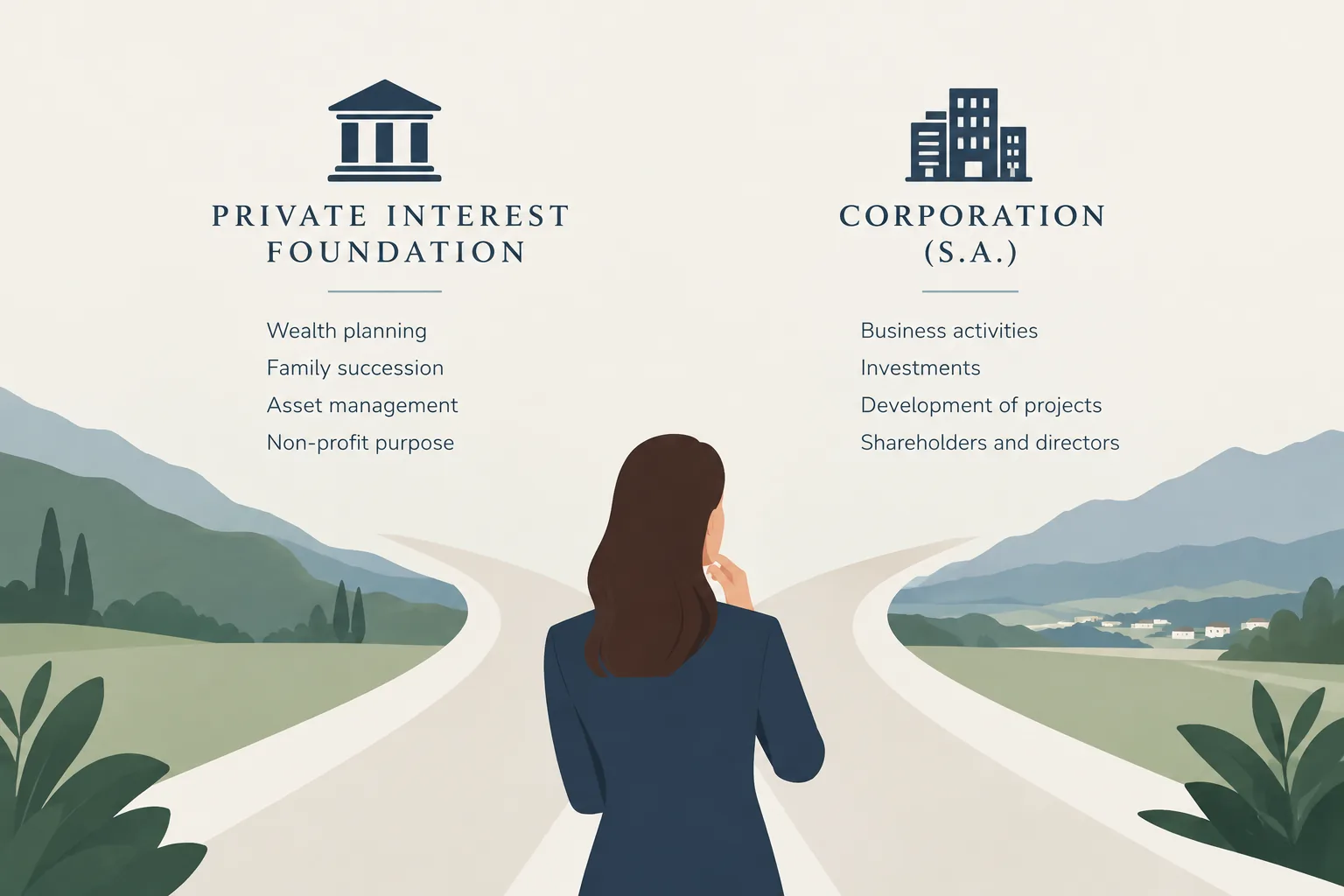
When a person or a family begins to accumulate wealth, they usually think about buying a house, a farm, an apartment, a rental property, investing in a business, or acquiring shares in a company.
There is, however, a question that is often raised too late: how should I legally organize my assets, thinking not only about the present but also about the future?
This question becomes especially important when there are several assets, family businesses, investments, or properties that will eventually have to be managed or transferred to children, relatives, or other beneficiaries.
Panama offers different legal structures that can be used to organize certain aspects of a person's estate. Among them are the Private Interest Foundation and the Corporation.
Although both may form part of an estate structure, they do not serve exactly the same function. For that reason, before deciding which one to use, it is important to understand their differences and to determine which structure, or even which combination of structures, genuinely responds to the needs of each person or family.
What is a Private Interest Foundation?
The Private Interest Foundation is governed in Panama by Law 25 of 1995. Under this legislation, one or more individuals or legal entities may create a foundation by establishing a patrimony devoted to the objectives or purposes set out in its foundation charter.
An important characteristic is that the Private Interest Foundation does not pursue profit.
This does not mean that it cannot hold assets or participate in corporate structures. Law 25 itself provides that a foundation may exercise the rights derived from shares representing the capital of commercial companies forming part of its patrimony, always within the framework established by the legislation.
For this reason, a Private Interest Foundation may form part of an estate and succession planning structure.
What does this mean in practical terms?
Consider a family that over several years has acquired different assets:
- A family home.
- A farm in Boquete.
- A property intended for rental.
- Shares in a family business.
- Financial investments.
- Other assets they wish to preserve and manage over the long term.
The problem is not necessarily owning these assets. The real challenge appears when the time comes to determine who will manage them, who will receive them, how decisions will be made, what will happen if the owner passes away, and how conflicts among beneficiaries will be avoided.
A properly designed estate structure can make it possible to establish rules and mechanisms that answer some of these questions in advance.
What is a Corporation?
The Corporation is a legal entity governed primarily by Law 32 of 1927. Panamanian legislation allows corporations to be incorporated for any lawful purpose and establishes a regime based, among other elements, on shares, shareholders, directors, and officers.
By its very nature, the Corporation can be particularly useful when there is a business or commercial activity that must be organized through a legal entity. For example:
- A family business.
- A company dedicated to professional services.
- A construction company.
- A rental or asset management activity.
- A company that develops real estate projects.
- A company used to make investments.
In these cases, the corporation can serve as the legal vehicle to develop and manage a business activity.
Foundation and Corporation: they are not the same
One of the most frequent mistakes is to assume that both structures are interchangeable. They are not necessarily so. A simple way to understand the difference is to think about the purpose one wishes to achieve.
Private Interest Foundation
- Purpose: oriented toward the aims established in its foundation charter.
- Profit: does not pursue profit.
- Typical use: may be used within estate planning.
- Shareholdings: may hold shares in commercial companies.
- Management: governed by a Foundation Council.
- Timing of effects: may take effect from its creation or after the founder's death.
Corporation
- Purpose: may be incorporated for any lawful object.
- Profit: may carry out business activities.
- Typical use: may be used as a vehicle to develop businesses.
- Shareholdings: structured around shares and shareholders.
- Management: governed by shareholders, directors, and officers.
- Timing of effects: its structure allows the participation and administration of a business to be organized.
The choice should not be made simply because one structure is better than the other. The right question is what you want to achieve, and which legal structure allows you to achieve it properly.
Why can this be relevant for a family in Boquete?
Boquete is an area where many people and families hold residential properties, farms, investments, businesses, and other assets.
For a person who owns a single home and has no other assets, a complex estate structure may not be necessary. But the situation can be different when a family has accumulated assets over decades.
Consider, for example, a family that owns a farm, a family home, two rental properties, and a stake in a business.
While all family members are alive and the relationship among them is good, managing these assets may seem straightforward. But what happens when one of the owners passes away?
The assets may become part of a succession proceeding, and questions may arise about their management, distribution, and future. If there are also several heirs with different interests, the situation can become more complex.
For this reason, estate planning should not begin when a death occurs. Ideally, it should be analyzed in advance.
Succession planning: thinking today about tomorrow
One of the most interesting aspects of the Private Interest Foundation is that Law 25 allows a foundation to be established so that it takes effect either from the moment of its creation or after the founder's death. This can make it a relevant tool within certain succession planning strategies.
Succession planning is not simply about asking who will inherit the assets. It also involves asking:
- Who will manage certain assets?
- How will benefits be distributed?
- What will happen to shares in a family business?
- How will the properties be handled?
- What rules will apply to the beneficiaries?
- What happens if one of the beneficiaries is a minor?
- How can a family property be kept from being fragmented among several heirs?
- What mechanisms exist to preserve certain assets over the long term?
These questions can be particularly important when the family estate includes properties of considerable value or businesses that depend on organized management.
A practical example
Suppose a person has spent years building a business in Panama and has also acquired several properties in Boquete. They have three children.
Their concern is not only that their children receive the estate. They also want to ensure that:
- The assets continue to be properly managed.
- Business holdings do not generate conflicts among the heirs.
- Clear rules exist regarding the beneficiaries.
- The estate can remain organized across the following generations.
In a situation of this kind, it may be advisable to analyze different estate planning alternatives. One possibility could involve a corporation to carry out certain business activities and, depending on the circumstances, a Private Interest Foundation within a broader structure.
But the appropriate structure will depend on the specific characteristics of the estate, the people involved, the assets, and the family's objectives. There is no single formula applicable to every case.
Does a Foundation automatically protect all assets?
No. This is a fundamental point.
A Private Interest Foundation should not be presented as a mechanism that makes assets automatically untouchable or that eliminates any legal liability. Estate planning must be carried out in compliance with existing legal obligations and taking into account the specific circumstances of each case.
In addition, Panama currently has legislation concerning the identification and registration of ultimate beneficial owners of legal entities, so estate structures must be analyzed within the regulatory framework in force.
For this reason, terms such as absolute anonymity, total protection, or shielding against any claim can be misleading when used to describe these structures. The goal must be legitimate, properly structured legal planning.
Can a Foundation own a Corporation?
Yes. Law 25 expressly provides that foundations may exercise the rights derived from shares representing the capital of commercial companies forming part of their patrimony.
This helps explain why, in certain estate structures, a Private Interest Foundation and a Corporation can serve different but complementary functions. In simplified terms:
- Private Interest Foundation: may hold certain assets or shareholdings.
- Corporation: carries out the business activity.
The specific structure must be designed according to the circumstances and objectives of each client.
When should estate planning be considered?
It is not necessary to wait until you have an extraordinarily large estate. It may be worth analyzing when a person:
- Has acquired several properties.
- Has children or relatives who will eventually receive their assets.
- Owns a family business.
- Holds interests in different companies.
- Owns investment properties.
- Is acquiring assets in Panama from abroad.
- Wishes to establish clear rules for the future management of their estate.
- Wants to anticipate possible succession conflicts.
Nor should planning be regarded exclusively as a tool for older people. Planning does not mean waiting for something to happen: it means making decisions while you still have the capacity to decide how you want your estate organized.
So, Foundation or Corporation?
The answer depends on the objective.
If the main need is to carry out a business activity, a Corporation may be a structure worth analyzing.
If the objective relates to estate planning, succession, and the administration of certain assets according to previously established rules, a Private Interest Foundation may be an alternative worth considering.
And in some cases it is not a matter of choosing one or the other, but of analyzing how different legal vehicles can form part of an integrated structure.
Before setting up a structure, ask the right questions
Before creating a Private Interest Foundation or a Corporation, it is worth analyzing:
- What assets currently exist, and who owns them?
- What activity is intended to be carried out?
- Who will the beneficiaries be?
- What will happen to the assets in the event of death?
- Are there family businesses involved?
- Are there tax or regulatory obligations to consider?
- Are there assets or beneficiaries in different jurisdictions?
- What level of administration and maintenance will the structure require?
These questions allow the legal structure to respond to a real need, rather than creating an entity simply because it seems convenient.
Planning your estate is also planning your family's future
Estate planning is not only about protecting assets. It can also be about organizing responsibilities, establishing rules, and reducing uncertainty for the future.
For a family that has built its wealth over many years, good planning can make it possible to analyze in advance what will happen to their properties, investments, and businesses when the time comes to transfer them to the next generation. In places like Boquete, where many families own properties, businesses, and investments, this conversation can be especially relevant.
The best structure is not necessarily the most sophisticated one, but the one that properly responds to the specific needs of the person or family and complies with the legislation in force.
For this reason, before setting up a Private Interest Foundation or a Corporation, it is advisable to carry out an individualized legal analysis of the estate, the objectives, and the circumstances of each case.
Do you have questions about organizing your estate in Panama?
At Moisés Ríos Law we can analyze your particular situation and advise you on the legal alternatives available for estate, corporate, and succession planning.
Proper planning begins long before it becomes necessary.