Real Estate & Investment
Property Title vs. Possessory Rights in Panama: The Difference Every Buyer Must Understand
Published on July 14, 2026. Lic. Moisés Iván Ríos Beitia
Understanding the difference between a registered property title and possessory rights is crucial when buying real estate in Panama. Learn the key differences, risks, and verification steps.
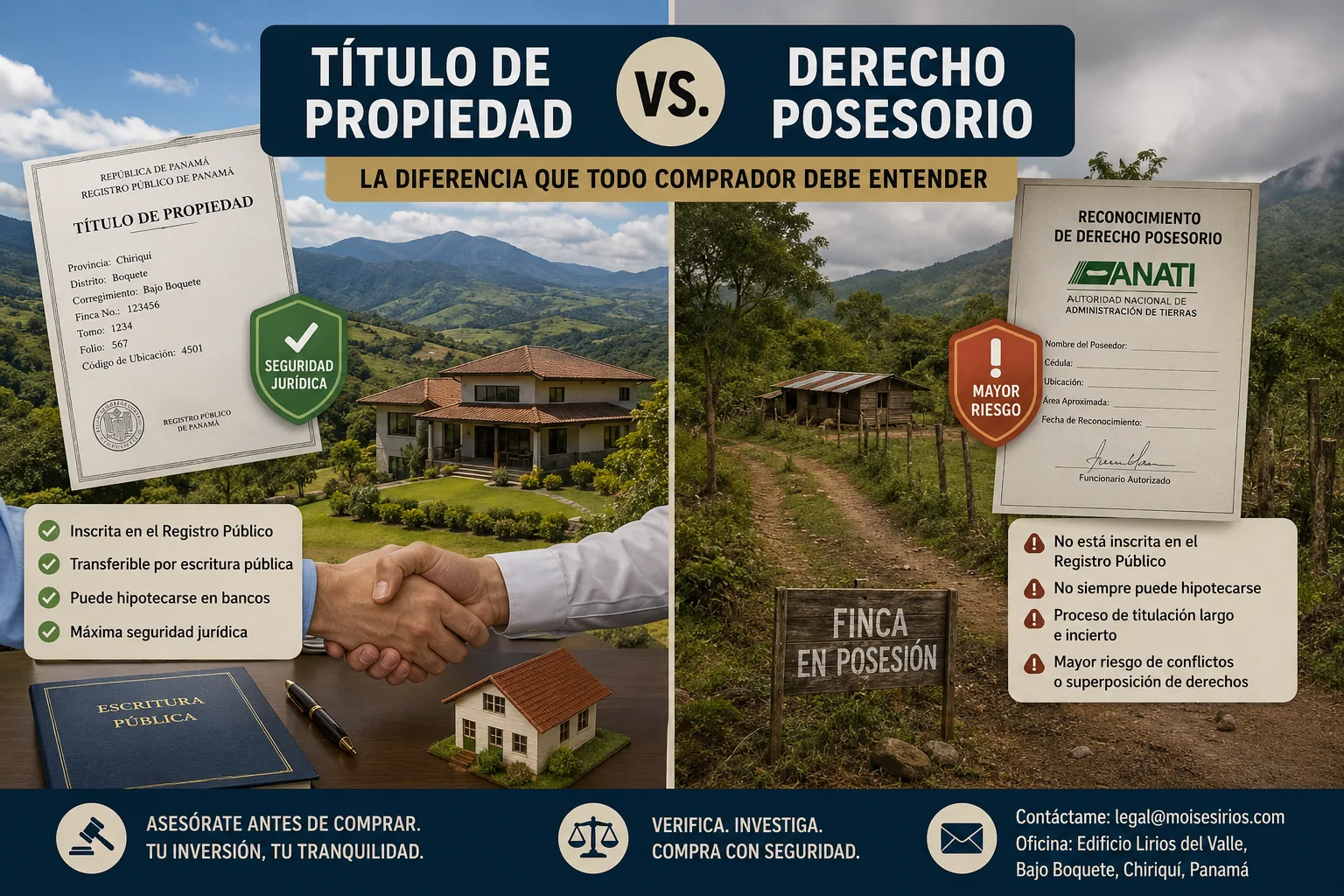
If you have searched for real estate in Panama, particularly in the highlands of Boquete or other rural regions, you have undoubtedly encountered two critical terms: property title and possessory rights. While real estate listings and casual conversations often treat these concepts as interchangeable, they represent entirely different legal structures under Panamanian law, carrying vastly different implications for your investment.
Understanding this fundamental distinction before committing to a purchase can prevent years of costly legal complications.
What is a Registered Property Title?
A registered property title represents the highest level of ownership security in the Republic of Panama. It confirms that the land is formally recorded in the Public Registry, complete with a unique property number, volume, and folio. Under this structure, the State officially recognizes the owner of the land, making this information transparent, public, and easily verifiable.
Transferability:
Property transfers are executed through a public deed and registered directly in the Public Registry.
Access to financing:
The registered property can be used as collateral to secure mortgages with Panamanian banks standardly.
Legal security:
It provides robust legal protection against third-party claims, backed directly by the State.
Transaction process:
The buying and selling process is relatively quick, secure, and standardized across all notary offices in the country.
What are Possessory Rights?
Possessory rights represent an administrative recognition that an individual has occupied, worked, or maintained a piece of land continuously, publicly, and in good faith. However, the land itself is not registered in the Public Registry. In Panama, this status is typically processed and acknowledged by the National Land Administration Authority (ANATI).
Registration status:
The land lacks registration in the Public Registry, relying instead on administrative recognition of physical possession.
Transfer of rights:
Transfers are executed through a contract of transfer of possessory rights or a sworn declaration of improvements. This is a different and less secure process than a registered deed.
Bank financing:
Traditional banks generally do not accept possessory rights as collateral for mortgages, with very few exceptions.
Titling process:
It is possible to eventually obtain a registered title through a formal titling process with ANATI, though this procedure is complex, time-consuming, and not guaranteed.
The Prevalence of Possessory Rights in Boquete
In the rural and mountainous areas of the Chiriqui province, many families have inhabited and worked properties for generations without ever completing the formal titling process. This situation is particularly common in lands situated far from urban centers, properties passed down through generations without formal estate administration, or regions where previous government land-titling programs remained incomplete.
While possessory rights do not render a property valueless, they require a buyer to conduct exhaustive due diligence to understand exactly what is being acquired.
Significant Risks of Purchasing Possessory Rights
Overlapping claims:
A lack of clear boundaries can lead to boundary disputes or multiple parties claiming possessory rights over the same land.
Financing limitations:
Because traditional banks reject possessory rights as collateral, securing financing is extremely difficult, which also limits the pool of future buyers.
Unpredictable titling processes:
Attempting to convert possessory rights into a registered title involves a lengthy administrative process that can span several years without a guaranteed outcome.
Reduced market liquidity:
Many buyers, particularly international investors, refuse to purchase properties without registered titles, significantly reducing future resale options.
Should You Avoid Possessory Rights Entirely?
Not necessarily. Many of the most beautiful properties in Boquete, offering exceptional views and microclimates, are held under possessory rights. Purchasing such land can be a sound investment, provided it is done with professional guidance.
Success depends on verifying the legitimacy of the possession, confirming the absence of neighbor disputes, and realistic budgeting for the time and cost of eventual titling. The critical error is purchasing a property without verifying its legal status, under the assumption that possessory rights and registered titles are identical.
Essential Verification Steps for Buyers
Cadastral study:
Request either the registered property number or the official ANATI recognition documents from the seller.
Public Registry search:
Perform a direct search in the Public Registry to verify the existence of a registered title.
Pending applications:
Check if there are any active titling applications currently in progress with ANATI.
Transfer history:
Review the history of prior transfers to confirm a continuous and peaceful chain of possession.
Conclusion
The distinction between a registered title and possessory rights is not a minor detail: it defines the safety of your capital, the ease of future resale, and your access to financing. Before making any financial commitment on a property in Panama, especially in rural areas like Boquete, it is essential to have an attorney verify the exact legal status of the land.
If you are currently evaluating a property and require verification of its legal standing, my office is available to assist you before you make any commitments.
Contact: legal@moisesirios.com
Office: Edificio Lirios del Valle, Bajo Boquete, Chiriqui, Panama